


Restaurant Concept Development: The Foundation of a Profitable F&B Business
Introduction
Many people who want to open a restaurant start with the interiors or the menu. They think about how the space will look, what kind of lighting they want, or which dishes they want to serve. But this is one of the biggest mistakes in the food and beverage industry. Without a clear concept, even a beautiful restaurant with great food can struggle to survive.
Most restaurants fail not because the food is bad, but because there is no clarity. There is no clear identity, no defined customer, and no strong positioning in the market. When a restaurant tries to be everything for everyone, it ends up connecting with no one.
At Zion Hospitality, concept development is the first and most important step in building a successful restaurant. Before we talk about menu design, kitchen layout, or branding, we define the core idea. Under the leadership of Chef Ajay Chopra, who brings years of culinary and operational experience, we focus on building concepts that are clear, practical, and profitable.
What is Restaurant Concept Development?
Restaurant concept development is the process of creating a clear and detailed plan for your restaurant before it is built. It is like a blueprint for your entire business. Just like a building cannot stand without a strong foundation, a restaurant cannot succeed without a strong concept.
A restaurant concept defines what your restaurant stands for. It answers important questions such as: Who are you serving? What kind of food will you offer? What price range will you operate in? What type of dining experience will guests have?
A strong concept includes a clearly defined target audience. You must know whether you are serving families, young professionals, corporate clients, luxury diners, or college students. When you know your audience, you can design everything around their needs and preferences.
In simple terms, restaurant concept development connects your vision with commercial reality. It makes sure that your idea is not just creative, but also financially viable. It aligns your passion with market demand. When done correctly, it reduces risk and increases the chances of long-term success.
At Zion Hospitality, we treat concept development as a strategic process. We combine market research, operational knowledge, and creative thinking to shape restaurant ideas that are not only exciting but also sustainable and profitable.
Why Concept Development is Critical for Profitability
Without Clarity, Even Great Food Fails
Many restaurant owners believe that if the food tastes good, the business will automatically succeed. But in reality, great food alone is not enough. A restaurant can serve excellent dishes and still shut down within a few years if the concept is not clear. Industry reports often suggest that a large percentage of restaurants struggle or close within the first 3 to 5 years. One of the main reasons is lack of strategic clarity at the beginning.
Brand inconsistency also reduces repeat customers. If your branding says “luxury dining” but your service feels casual, or if your interiors feel modern but your menu feels traditional without explanation, customers get confused. Confused customers rarely return. A clear concept ensures that food, service, interiors, pricing, and communication all tell the same story.
Marketing becomes difficult without defined positioning. When you do not know exactly who you are targeting, your advertisements become generic. Your social media messaging becomes unclear. Strong positioning makes marketing more effective because you know exactly what to say and whom to say it to.
Investors also look for strong concept clarity. Before investing, they want to understand the business model, target audience, differentiation factor, and financial projections. A well-developed concept shows that the restaurant is not based only on passion, but also on planning and research. Clear concept development reduces risk, builds investor confidence, and increases long-term profitability.
Zion Hospitality’s Structured Concept Development Approach
At Zion Hospitality, concept development is not based on guesswork. It is a structured and strategic process. We follow clear steps that combine creativity with research and financial planning. This approach helps transform bold ideas into sustainable, market-ready restaurants.
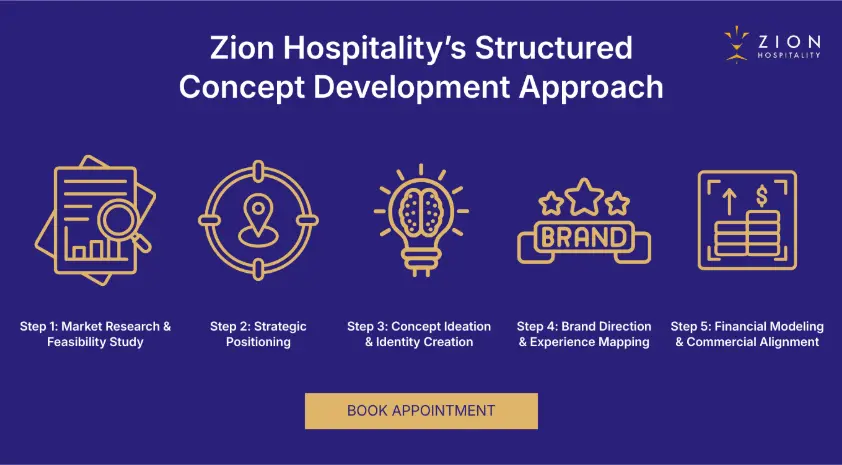
Step 1: Market Research & Feasibility Study
The first step is understanding the market. Before defining any concept, we study the environment where the restaurant will operate. This includes local competition analysis. We look at what other restaurants in the area are offering, their pricing, customer reviews, and positioning. This helps us identify gaps in the market.
Gap identification is very important. If ten similar cafés already exist in one area, opening another identical café may not be profitable. Instead, we look for unmet needs or underserved segments.
We also study consumer spending behavior. How much are people willing to spend in that location? What are their dining habits? Do they prefer delivery, casual dining, or premium experiences? Understanding spending patterns helps create realistic pricing and revenue projections.
Cuisine trends are also evaluated. We examine what is trending nationally and locally. However, we do not blindly follow trends. We assess whether a trend is sustainable and suitable for the target audience.
Demographic study plays a key role. We analyze age groups, income levels, lifestyle patterns, and cultural preferences in the area. A young urban crowd will have different expectations compared to a family-oriented residential neighborhood.
Finally, we assess location viability. Footfall potential, accessibility, parking, visibility, and rental cost all impact financial success. Proper research at this stage reduces financial risk and prevents costly mistakes later.
Step 2: Strategic Positioning
Once research is complete, we define the restaurant’s positioning. This step answers one key question: Where does this restaurant stand in the market?
We clearly define the target audience. Are we serving corporate professionals, families, young millennials, luxury diners, or health-conscious guests? Every decision from this point forward depends on this clarity.
We determine whether the restaurant will be premium, mid-scale, or casual. Each level has different expectations for interiors, service style, portion size, and pricing.
We also decide whether the concept is occasion-based dining, such as celebration restaurants, or everyday dining spaces. Some restaurants are experience-driven, where guests pay for ambience and storytelling. Others are value-driven, focusing on affordability and speed.
Price positioning is aligned with the audience and format. Clear positioning influences menu design, kitchen equipment, staffing levels, branding style, and marketing communication. When positioning is strong, the entire business moves in one clear direction.
Step 3: Concept Ideation & Identity Creation
After positioning, we move to creative ideation. This is where the restaurant’s core story is built. Every successful restaurant has a reason to exist beyond just serving food. We define the emotional hook that connects guests to the brand.
The cuisine direction is clearly shaped at this stage. For example, Sobombae celebrates Mumbai’s diverse regional flavors with a strong storytelling approach. Paashh focuses on conscious vegetarian dining in a calm and earthy setting. Saraza represents a multi-format hospitality experience under one unified brand. Each of these concepts is rooted in a clear identity.
We define the differentiation factor. What makes this restaurant different from competitors? It could be a unique format, a signature cuisine style, or a distinctive guest experience.
The unique selling proposition (USP) is refined. This becomes the central message that customers remember and talk about. A strong USP strengthens brand recall and customer loyalty.
Step 4: Brand Direction & Experience Mapping
Once the identity is defined, we develop the brand direction. This includes selecting the right brand name that reflects the concept and is easy to remember.
Logo and visual identity are designed to match the positioning. Colors, typography, and design language must align with the restaurant’s personality.
The tone of voice is also defined. How does the brand communicate? Is it playful, sophisticated, minimal, or bold? Consistent communication builds trust.
Interior direction is aligned with the concept story. The space should visually express what the brand stands for. A mismatch between concept and interiors creates confusion.
We also map the guest journey. From entry to seating, ordering, dining, and exit, every touchpoint is planned. Experience mapping ensures that guests feel the concept at every step.
Social media personality is defined so that online presence matches offline experience. Consistency across all platforms strengthens brand identity and increases customer engagement.
Step 5: Financial Modeling & Commercial Alignment
The final step is aligning creativity with numbers. At Zion Hospitality, profitability is always a priority. We prepare revenue projections based on realistic assumptions and market data.
Food cost structure is carefully planned. Ingredient sourcing, portion control, and pricing strategy are aligned to maintain healthy margins.
We define the ideal menu mix. This ensures a balance between high-margin dishes and popular crowd favorites. Menu engineering supports profitability without compromising guest satisfaction.
Break-even planning is done to understand how long the restaurant will take to recover initial investment. This helps owners and investors plan cash flow effectively.
Return on investment (ROI) forecasting gives clarity on long-term financial performance. When financial modeling is integrated into concept development, the restaurant is built on both passion and practicality.
Through this structured approach, Zion Hospitality ensures that every restaurant concept is not only creative and inspiring, but also commercially strong and sustainable.
How Strong Concept Development Creates Scalable Brands
Strong concept development does more than just help a restaurant open successfully. It creates a structure that allows the brand to grow, expand, and scale. When the core idea is clear, it becomes easier to replicate the model in new locations and formats.
For example, Saraza represents a multi-format hospitality concept under one brand. Instead of being just a single restaurant, it brings together banquet spaces, a bistro, a café, and other dining formats within one unified identity. This scalability is possible because the concept was clearly defined from the beginning. Each format operates under the same strategic vision while serving different customer needs.
Sobombae is another example of strong concept clarity. It celebrates Mumbai’s diverse culinary traditions with a clear storytelling approach. The identity is rooted in regional flavors and cultural emotion. Because the concept is focused and authentic, it builds strong brand recall and customer loyalty. This kind of clarity makes it easier to market and expand.
Paashh demonstrates lifestyle positioning. It is not just about vegetarian food; it represents conscious dining and a calm, earthy ambience. The concept speaks to a specific audience that values mindful living and modern flavors. When a brand connects deeply with a lifestyle segment, it becomes more than just a restaurant — it becomes part of the customer’s identity.
These examples show that scalable brands are built on strategic clarity. When the concept is strong, decisions about menu, interiors, marketing, and expansion become easier and more consistent. Clear concept development transforms a single restaurant idea into a long-term brand opportunity.
Who Needs Professional Concept Development?
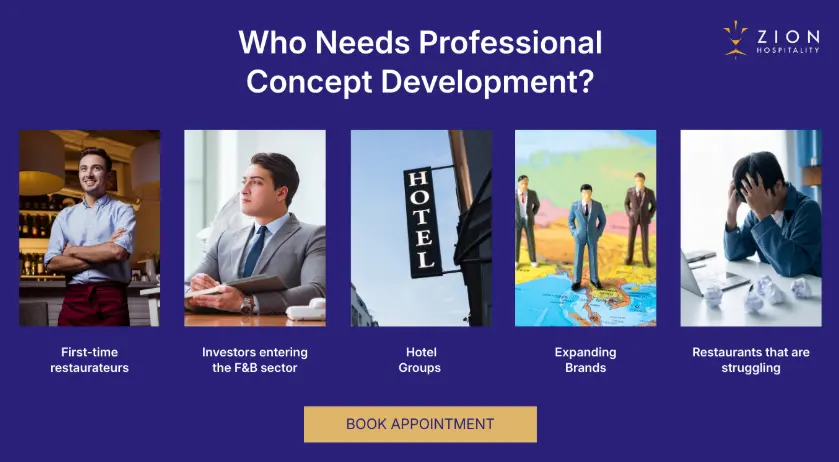
Professional concept development is valuable for anyone entering or operating in the food and beverage industry. It reduces risk, improves clarity, and increases the chances of long-term success.
First-time restaurateurs benefit greatly from structured concept planning. Many new entrepreneurs have passion and ideas but lack industry experience. Professional guidance helps transform ideas into realistic and profitable business models.
Investors entering the F&B sector often look for clear feasibility, defined positioning, and financial projections. Concept development provides structured documentation and strategic clarity, which builds confidence and reduces uncertainty.
Hotel groups launching new dining outlets require strong differentiation within competitive markets. A clear concept ensures that each outlet has its own identity while still aligning with the overall brand vision of the hotel.
Expanding brands need structured concept documentation to maintain consistency across multiple locations. Without clear guidelines, expansion can dilute brand identity. Professional concept development creates a scalable and repeatable model.
Restaurants that are struggling or looking to reposition can also benefit. Sometimes performance issues are not operational, but conceptual. Redefining positioning, audience, and brand story can revive customer interest and improve profitability.
In all these cases, professional concept development acts as a strategic roadmap. It transforms ideas into structured, market-ready restaurant businesses with clarity, confidence, and commercial strength.
Why Choose Zion Hospitality for Concept Development?
Choosing the right partner for concept development is an important decision. The foundation of your restaurant will depend on the clarity, strategy, and experience brought into the planning stage. At Zion Hospitality, concept development is guided by practical industry knowledge and real execution experience.
Chef Ajay Chopra brings years of hands-on expertise in the culinary and hospitality industry. His experience goes beyond recipes and creativity. It includes understanding kitchen efficiency, food costing, guest behavior, service standards, and brand positioning. This balanced knowledge ensures that every concept is both inspiring and realistic.
What makes a difference is real operational experience. Concept ideas are not created in isolation. They are shaped by understanding how restaurants actually function day-to-day. From staffing challenges to cost control, from workflow planning to guest satisfaction, operational insight plays a key role in building concepts that can perform consistently.
With more than 30 restaurant concepts successfully executed, Zion Hospitality has worked across different formats and markets. This experience allows us to recognize patterns, avoid common pitfalls, and design concepts that are adaptable and scalable. Each project adds to a deeper understanding of what works and what does not.
Turnkey execution capability is another strength. Concept development is not just about creating a document. It is about translating that concept into reality. Because Zion Hospitality offers end-to-end services — including menu development, kitchen planning, branding, and operational setup — the original vision remains consistent throughout the process.
The approach combines strategy, creativity, and commercial discipline. Strategy ensures market alignment. Creativity builds emotional connection and brand identity. Commercial discipline protects profitability. When these three elements work together, the result is a restaurant concept that is strong, structured, and sustainable.
Conclusion
A restaurant without a clear concept is a risk. It may look attractive at first, but without direction and positioning, it struggles to build loyalty and stable profits.
A well-developed concept, on the other hand, is an asset. It guides every decision, strengthens brand identity, supports financial planning, and creates a clear path for growth.
Strategy comes first. Execution follows with clarity and confidence.
If you are planning to build a new restaurant or redefine an existing one, it starts with the right concept. Book an appointment with Zion Hospitality and take the first step toward creating a structured, market-ready, and profitable restaurant.