

How to Attract More Walk-in Customers to Your Restaurant
By Zion Hospitality · Chef Ajay Chopra | F&B Consulting | 25 min read
Walk-in customers are the lifeblood of any successful restaurant. They represent impulsive decisions, neighbourhood trust, and the most organic form of growth — no algorithm, no ad spend, no delivery platform commission eating into your margins. Yet most restaurant owners treat walk-in footfall as a lucky bonus — something that happens on good days — rather than a designed, predictable outcome that can be systematically improved.
At Zion Hospitality by Chef Ajay Chopra, we have worked on more than 50 restaurant openings, repositionings, and turnarounds across India, Dubai, and Southeast Asia. From 20-cover fine-dining rooms to 300-seat casual chains, the principles that drive walk-in footfall are consistent — and they are entirely within your control.
This guide is the most comprehensive version of what we teach our consulting clients. Read it end to end, run the audit checklist at the close, and identify your single highest-leverage gap. Fix that gap before doing anything else.
Key Facts About Walk-in Customers:
-
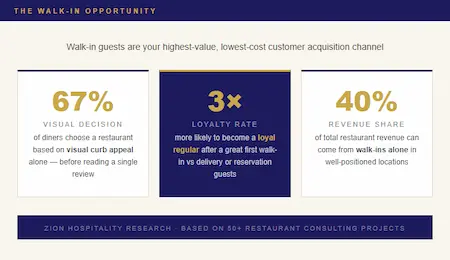
67% of diners say visual curb appeal is what made them choose a restaurant they had not visited before.
-
Walk-in guests are 3 times more likely to become loyal regulars after a great first experience compared to delivery or reservation guests.
-
40% of total restaurant revenue can come from walk-in guests alone in well-positioned, high-footfall locations.
Part One: The Curb Appeal Factor — Your Restaurant's Silent Salesman
Before a single word is spoken or a dish is tasted, your restaurant has already made its first impression. The facade, the signage, the lighting temperature at 8 PM on a busy street — all of these communicate to a passerby in under three seconds whether it is worth stepping inside. We call this the "Three-Second Decision" — and the majority of restaurants in India are failing it without even knowing.
Walk along any busy commercial stretch in Mumbai, Delhi, Bengaluru, or Hyderabad and count how many restaurant fronts genuinely invite you in as a first-time visitor. The number is startlingly low. Most storefronts are either visually cluttered — too much information competing for attention — or visually inert — so neutral they register nothing at all. Both outcomes are equally damaging. Both mean empty tables.
Curb appeal is not about spending enormous amounts on a new facade. Restaurants we have seen double their walk-in footfall made changes that cost less than a few thousand rupees — targeted, strategic improvements to the elements that matter most in that critical three-second window. The return on those improvements was often 10x within the first month.
The Three-Second Decision — How It Actually Works
Neuroscience research on visual decision-making shows that the human brain categorises a new visual environment within 100 milliseconds and makes a "safe / unsafe / interesting" judgement within three seconds. For restaurants, this means a potential guest walking past your entrance has already formed a gut opinion before their conscious mind has had a chance to evaluate your signage or read your menu board. You are selling to the emotional brain first — always.
The three cues that dominate this split-second decision are:
-
Light — Is this place alive and open? Does the entrance feel warm and welcoming or dark and uncertain?
-
Clarity — Do I immediately understand what kind of place this is? Can I picture myself inside?
-
Social proof — Do I see other people inside enjoying themselves? Is this restaurant busy and therefore good?
Every exterior decision you make should be evaluated through these three lenses. If a proposed change improves light, clarity, or social proof visibility — it will increase walk-ins. If it does not serve at least one of these three functions — reconsider it.
Why Most Indian Restaurants Fail the Exterior Test
In our consulting work across more than 50 restaurant projects, we have identified four recurring exterior failures that suppress walk-in traffic regardless of the quality of food or service inside:
-
Inconsistent or faded signage — Signage that was designed at launch but has since faded, been partially obscured by a new delivery platform sticker, or been supplemented with mismatched additions. The visual result is noise, not communication. Guests do not stop to decode a confusing exterior; they simply keep walking.
-
Dead entrance lighting — Harsh white tube lights or, worse, no dedicated entrance lighting at all. A warm, well-lit entrance is the single highest-ROI exterior improvement most restaurants can make. The cost of warm LED strips along your entrance canopy is minimal. The impact on evening walk-ins is immediate and significant.
-
No outdoor menu or pricing signal — Guests experience anxiety about walking into a restaurant without a rough sense of price point. An outdoor menu or a visible price range removes this anxiety. The guest who sees your price point and thinks "yes, that is in my budget" walks in confidently. The guest who has no information defaults to caution and keeps walking.
-
Concept confusion — A potential guest should know within three seconds whether they are looking at a fine-dining restaurant, a casual all-day cafe, a regional cuisine specialist, or a quick-service format. If your exterior does not clearly answer this question, the safest and easiest decision for the guest is to continue walking to something more legible.
Strategy 01 — Illuminate Your Entrance
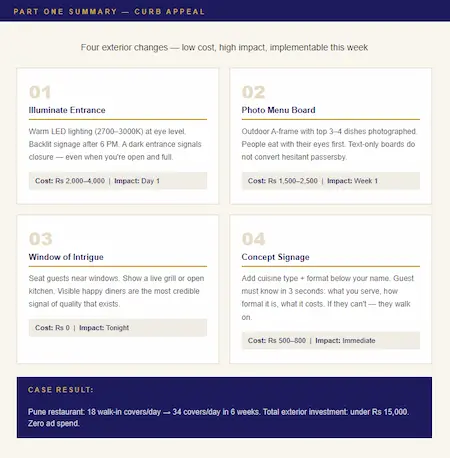
Warm lighting at the 2700–3000K colour temperature range draws people in psychologically. This is not an aesthetic preference — it is a physiological response. Warm light signals safety, comfort, and welcome to the human brain. A dark entrance, by contrast, signals closure or disorganisation — even when you are open and half-full and the food is exceptional.
Install directional warm spotlights over your entrance canopy. Backlight your signage after 6 PM. Ensure the interior is visible and looks inviting from the street — not over-lit (which feels clinical and cold) but well-lit enough to see happy people eating. The cost of this change is typically under Rs 5,000 for most establishments. The impact begins on the first evening of implementation.
Quick Win: Warm LED strip lights along your entrance frame, installed by any local electrician. Budget: Rs 2,000–4,000. Return: visible within one week.
Strategy 02 — Outdoor Menu Board With Food Photography
An outdoor A-frame board or wall-mounted display with high-quality dish photography converts hesitant passersby into curious walk-ins. Feature your top three to four bestselling dishes with their names, brief descriptions, and price points. Update it seasonally and with every new launch.
A chalkboard with text alone is not enough in 2025. People eat with their eyes before they eat with their mouths. A single well-photographed image of your most beautiful dish — plated properly, lit well, shot on a recent smartphone in natural light — will outsell a paragraph of text describing the same dish every single time. Invest in three to four good food photographs. Use them everywhere.
Quick Win: An A2-size printed photo menu in a weatherproof outdoor display frame. Print cost: Rs 500. Frame cost: Rs 800–1,500. Update every month or with each new seasonal menu.
Strategy 03 — Create a Window of Intrigue
A live kitchen view, an open grill station visible from the street, a dessert counter near the entrance, or simply visible happy guests enjoying their meal makes people stop mid-stride. This is the most powerful walk-in conversion trigger that exists: social proof delivered in real time, in person, through a window.
If your interior layout permits, prioritise placing your most energetic and photogenic elements near the front. Seat parties of two near your window seating first. Let the life of your restaurant spill outward toward the street. A dark, empty-looking interior — even when the back is full — communicates vacancy and failure. The restaurant that always looks busy draws more walk-ins simply because being busy is the most credible signal of quality.
Quick Win: Rearrange your front-of-house seating to prioritise the window. Brief your host to seat couples and small parties there first during off-peak hours.
Strategy 04 — Concept-First Signage
Within three seconds of seeing your exterior, a passerby should be able to answer these questions: What cuisine does this restaurant serve? Is this formal or casual? Is this expensive, mid-range, or affordable? Is it currently open?
Test this right now. Stand across the road from your own restaurant and time how long it takes you to answer those four questions clearly from your signage alone. If it takes longer than three seconds — or if you cannot answer one of the questions at all — you have a signage problem that is costing you walk-ins every day. The fix is often as simple as adding a cuisine type descriptor as a sub-line beneath your restaurant name.
Quick Win: Add a one-line descriptor beneath your restaurant name. Example: if your name is "Aromas," add "Authentic North Indian Kitchen" directly beneath. This one change eliminates concept confusion immediately.
The Compounding Effect of Exterior Improvements
Here is what most restaurant owners underestimate about exterior improvements: they compound. When you fix your entrance lighting and add a photo menu board and seat guests near the window, the result is not three times the impact of one individual change — it is significantly more, because you are now creating a coherent, compelling, multi-sensory story for the passerby's brain rather than three isolated signals.
One of our clients in Pune — a mid-scale North Indian restaurant with genuinely excellent food — was averaging 18 walk-in covers per day before our engagement. After a focused exterior audit and targeted changes costing under Rs 15,000 in total, walk-in covers rose to 34 per day within six weeks. No advertising spend. No delivery app promotion. No price changes. Pure exterior signal improvement. The food had always been good. Guests simply could not tell from the street.
Consulting tip: Walk past your own restaurant as a stranger — ideally with someone who has never visited. Do this at three different times: lunch hour, early evening, and peak dinner service. The experience is often genuinely startling. What feels obvious from the inside is frequently invisible from the street. Fresh eyes reveal gaps that daily familiarity hides.
Part Two: Digital Presence — The New Curb Appeal
Here is an uncomfortable truth about modern walk-in behaviour: most of your walk-in customers are not entirely spontaneous. Research consistently shows that a significant majority of guests — even those who appear to walk in on impulse — have already encountered your restaurant digitally in the hours or days before their visit. They saw a Reel. They read a Zomato review. They checked your hours on Google Maps while standing at the corner trying to decide which way to turn.
Your digital presence is therefore an extension of your physical storefront — and in many cases, it is the first storefront a potential guest ever sees. A Google Business Profile with blurry, outdated photos and no listed hours tells the prospective guest exactly the same thing a dark entrance says: we are not ready for you. We are not organised. We probably do not care that much.
The investment required to maintain a sharp, compelling digital presence is modest — a few focused hours per week, applied consistently. The return, however, is substantial and compounding. Every new photo you add to your Google profile works for you indefinitely. Every thoughtful review response you write is read by every future potential guest who views that review. Every geo-tagged Instagram post makes you discoverable in perpetuity to everyone searching that location.
Google Business Profile — Your Most Important Digital Asset
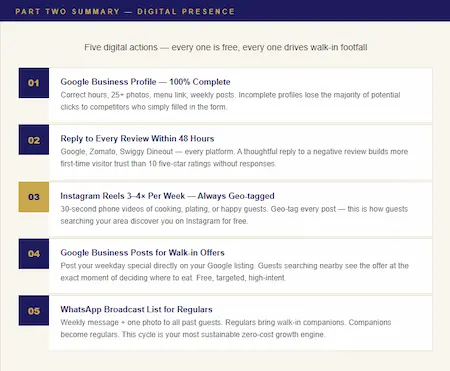
For walk-in restaurants, the Google Business Profile is the single most important digital asset — more important than Instagram, more important than Zomato, more important than your own website. The reason is intent: when someone is on Google Maps searching "restaurants near me" at 7:30 PM, they are already carrying the intent to go somewhere and eat right now. You are one tap away from a confirmed guest — or from being skipped entirely for a competitor who simply kept their profile current.
A fully complete and actively managed Google Business Profile includes all of the following:
-
Business name with accurate category (be specific — "North Indian Restaurant" is far better than simply "Restaurant" in search results)
-
Verified address with correct pin placement on the map
-
Opening hours for every day of the week, updated for public holidays and seasonal changes
-
Active phone number that is answered during operating hours
-
Menu link — ideally a direct PDF or your website menu, not a third-party aggregator link
-
Minimum 25 high-quality photos: exterior day and night, interior ambience, bar or drinks counter, kitchen or open cooking station, your top five to eight individual hero dishes, your team
-
Google Business Posts updated at least twice per week with current specials, new dishes, events, or walk-in offers
-
Questions and Answers section populated with the questions your guests actually ask most often
Profiles with complete information receive dramatically more engagement than incomplete ones. The Google algorithm also rewards completeness and activity with higher placement in local search results. This is entirely within your control and costs nothing but time.
Review Management — The Trust Engine That Never Sleeps
First-time walk-in guests read reviews. They read them on Zomato. They read them on Google. They read them on Swiggy Dineout. And critically — they read your responses to those reviews, because the response tells them far more about how you will treat them as a guest than the review itself does.
Consider the psychology: a potential guest reads a negative review that says "the service was slow." They then read your response: "We are genuinely sorry for your experience that evening. We spoke to our team the following day and have made specific changes to our service protocol. We would love to welcome you back and show you what we are truly capable of." That response tells the potential guest something enormously reassuring: this is a business run by people who listen, who care, and who take responsibility. That guest is far more likely to walk in than if you had simply ignored the review or posted a dismissive generic reply.
Set a firm rule: every review on every platform receives a personalised response within 48 hours. Positive reviews deserve genuine gratitude. Negative reviews deserve acknowledgement, specific corrective intent, and a warm invitation to return. Never argue with a negative reviewer publicly, even if they are wrong. The audience is not the reviewer — the audience is every future guest reading that exchange.
Instagram as a Walk-in Discovery Engine
Instagram has become the primary food discovery platform for urban Indian diners between the ages of 22 and 45 — exactly the demographic with the highest walk-in frequency and average spend. The mechanism is elegantly simple: someone sees a Reel of a beautiful dish being prepared or a dining room that looks genuinely inviting, they remember your restaurant name, and it becomes the first option that comes to mind when they are choosing where to eat this weekend.
You do not need a professional filmmaker or a dedicated content team. A clean, well-lit 30-second Reel of your chef plating your signature dish, or of your kitchen in the first hour of morning prep, or of a table of guests genuinely reacting with delight to a dish — shot on a recent smartphone and edited in CapCut or Reels editor — is enough. Consistency matters significantly more than production value. Three to four posts per week, every week, compounds into meaningful discovery over six to twelve months.
The single most important technical action you can take on Instagram to drive walk-in traffic is geo-tagging every post without exception. Geo-tagged posts appear in location-based searches. When someone in your neighbourhood opens Instagram and searches your area or nearby landmark, your geo-tagged content appears. This is hyper-targeted, zero-cost local advertising — and most restaurants in India are not doing it.
WhatsApp Broadcast — The Most Underused Walk-in Tool
Every regular guest whose phone number you have collected — whether through a reservation, a loyalty card, a feedback form, or a personal relationship — is a potential member of your WhatsApp broadcast list. A weekly message to this list — "Good evening from our kitchen — this week we have a new seasonal biryani and our famous gulab jamun cheesecake is back by popular demand" accompanied by one beautiful photograph — costs nothing and takes five minutes to send.
The impact is disproportionate. Regular guests who receive your message remember you exist and choose you over a new option for their next dinner. They bring companions who have not visited before. Those companions experience your restaurant, enjoy it, and become the next generation of regulars. This cycle — regulars bringing walk-in companions who become regulars — is the most organic and sustainable growth engine available to any restaurant.
Part Three: In-Store Psychology — Converting Curiosity Into a Seated, Ordering Guest
A guest who has stepped through your door has cleared the single hardest hurdle. They have made a conscious positive decision. But here is what most restaurateurs fundamentally underestimate: that decision is fragile. Walk-in guests — especially first-timers — arrive in a state of mild social anxiety. They do not know the layout. They do not know the protocol. They are not sure where to stand or whether to wait or whether to seat themselves. They are hyper-alert to signals of whether they belong here, whether they will be welcomed, and whether they made a good choice.
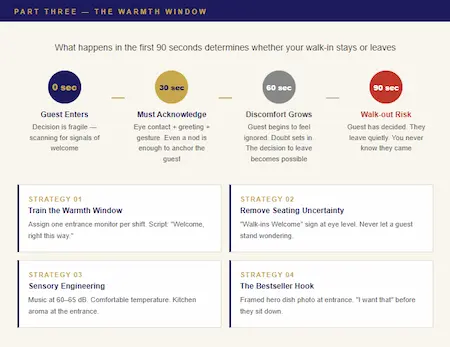
Any negative signal in that first 90 seconds — a moment of being ignored by staff walking past, a confusing seating arrangement, a space that is far louder or more formal or colder than they expected — can tip them from curious to uncomfortable. And an uncomfortable first-time guest who has not yet sat down will simply leave. Quietly, without making a scene, without explaining why. You will never know they came. You will never know you lost them. This is the silent revenue leak that costs restaurants more than they ever realise.
The Warmth Window — The 30 Seconds That Determine Everything
We call the first 30 seconds after a guest enters the "Warmth Window" — and it is the most consistently under-managed phase of the restaurant experience in India. Hospitality psychology research is consistent and unambiguous on this point: guests who receive a warm acknowledgement within the first 30 seconds of entering are significantly more likely to stay, order more, and rate their experience positively — even if service quality at some point later in the meal is merely average.
The early impression creates a psychological halo that colours everything which follows. Conversely, guests who are ignored for even 90 seconds — even if every subsequent interaction is excellent, the food is extraordinary, and the bill is appropriate — report feeling less welcome and less satisfied with their overall experience. The window is short. The impact is disproportionate. The cost of getting it right is nothing more than a training conversation and a cultural expectation set from the top.
Strategy 01 — Train Every Staff Member for the Warmth Window
The Warmth Window protocol is simple: eye contact, verbal greeting, and a welcoming gesture within 30 seconds of a guest entering. Even in the busiest peak service period — when every table is full and staff are moving quickly — a nod, a raised hand, and a clear "Welcome, we'll be right with you" is sufficient to anchor the guest, signal that they have been seen, and eliminate the anxiety that drives silent walk-outs.
What is categorically not acceptable is the common scenario in which a guest stands at the entrance for 60 to 90 seconds while staff bustle around them without making eye contact or acknowledgement. From the guest's perspective, this communicates: you are not important enough to interrupt what we are doing. That guest will frequently leave — and will tell at least one other person about the experience.
Implement this in your next pre-service briefing. Assign one specific staff member during each shift as the designated entrance monitor — their explicit responsibility is to ensure no walk-in guest goes unacknowledged beyond 20 seconds. Track the metric. Review it in your post-service debrief. Celebrate when the team gets it right.
Recommended greeting script: "Welcome, please come in! I'll find you a table right away" or "Welcome — are you joining us for lunch/dinner today? Wonderful — please follow me."
Strategy 02 — Remove the Uncertainty of Seating
One of the most overlooked conversion barriers in walk-in restaurants is seating uncertainty. First-time guests do not know whether they should wait at the entrance, seat themselves, look for a host, or walk to the bar. This uncertainty is uncomfortable. When uncertain, most people default to retreat — they leave rather than risk doing the wrong thing.
The solution is simple: eliminate the uncertainty with clear physical signals and immediate human direction. A visible sign at eye level near the entrance — "Walk-ins Welcome / Please Wait to Be Seated" — removes 80% of this anxiety before any staff interaction occurs. A host or senior server who makes eye contact and says "Right this way" with a gesture removes the remaining 20%. No ambiguity. No awkward hovering. No silent walk-outs caused by confusion about protocol.
Strategy 03 — Sensory Engineering
The sensory environment your guests enter is not incidental — it is a conversion tool. Background music at the right volume, a pleasant kitchen aroma reaching the entrance area, and a comfortable ambient temperature are subconscious signals that make guests feel at ease and make the decision to stay feel correct — before they have even seen the menu.
Background music should be loud enough to create atmosphere but quiet enough for guests to converse comfortably without raising their voices. The benchmark is simple: if two guests seated across from each other need to lean forward to hear each other clearly, the music is too loud. Measure with a phone decibel metre — 60 to 65 dB at the table is the target range.
Temperature is frequently underestimated in Indian restaurants. Aggressive air conditioning — especially near the entrance — creates an immediate physical discomfort that makes guests want to leave before they have settled. The entrance zone and dining room should feel comfortable and welcoming, not cold.
Kitchen aroma is perhaps the most powerful and least utilised sensory tool available to restaurants. If your kitchen produces aromatic cooking — grilled meats, fresh bread, spiced curries — and that aroma can be subtly directed toward the entrance area, you have a walk-in conversion tool that cannot be replicated by any marketing campaign.
Strategy 04 — The Bestseller Hook
A vivid, professionally photographed display of your most iconic dish positioned near the entrance creates an "I want that" response in a guest before they have been seated, before they have opened the menu, and before a single word has been exchanged between them and your staff. This is the most powerful pre-seating conversion trigger available — it anchors the decision to stay before any rational evaluation of the menu begins.
The display does not need to be elaborate. A framed A3 or A2 photograph of your signature dish, printed with high quality, with the dish name and a three-word description positioned at eye level near the entrance — "Slow-Cooked Dal Makhni. 24 hours. Always." — is enough. The guest who sees that image and feels hungry has already decided to stay, even before your host has said a word.
Menu Design as a Walk-in Retention Tool
Once a walk-in guest is seated, the menu is the next critical conversion point. An overwhelming menu — 60 or 80 items across six pages covering every cuisine in existence — increases decision anxiety and paradoxically reduces the average order value. When guests cannot confidently choose, they default to the safe and familiar — which is rarely your most interesting or highest-margin dish.
A walk-in-optimised menu highlights three to five signature or recommended dishes visually and with brief, evocative descriptions. It creates clear anchors — "Most Popular," "Chef's Recommendation," "Since Day One" — that guide the uncertain first-time guest toward confident decisions. Every first-time walk-in guest should be given one warm verbal recommendation by their server within 30 seconds of being handed the menu. Not a sales pitch — a genuine suggestion from someone who knows the kitchen. "If it's your first time here, I'd start with the lamb chops — they're what we're known for." That single sentence does more for guest satisfaction and average order value than any menu redesign.
Part Four: Footfall-Driving Offers — Adding Value Without Eroding Your Brand
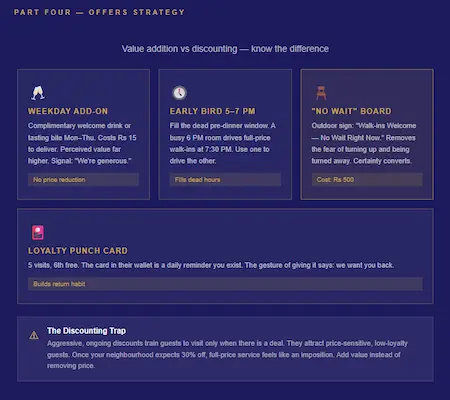
The instinctive response to low walk-in traffic is almost universally the same: discount. Put up a banner, offer 30% off, list a deal on Zomato Gold, run a half-price lunch promotion. And in the short term, this works — footfall rises. But the medium-term consequences are predictable and damaging.
Aggressive discounting trains your guests to visit only when there is a deal. It attracts price-sensitive guests who have the lowest loyalty, the highest demands, and the least likelihood of becoming valuable regulars. It establishes a reference price in your neighbourhood's perception that is very difficult to walk back — once people know your food can be had for 30% less, full-price service will feel like an imposition rather than fair value. And it communicates, subtly but unmistakably, that your food is not worth the price you usually charge.
The right strategy is not discounting — it is perceived value addition. The difference is meaningful: you are not reducing your price, you are increasing what the guest gets for the same price. A complimentary welcome drink is not a discount — it is hospitality. A free dessert for early bird guests is not a coupon — it is a reward for loyalty. These distinctions matter enormously to how guests perceive and talk about your restaurant.
Offer 01 — Weekday Walk-in Experience Add-on
A complimentary welcome drink, an amuse-bouche, a chef's tasting bite, or a free dessert for walk-in guests on Monday through Thursday adds significant perceived value without touching your price card or communicating discount. The cost to you is minimal — a small glass of nimbu paani or a two-bite appetiser that costs Rs 15 to make. The perceived value to the guest is far higher. More importantly, the emotional signal it sends — "we want to give you something extra" — creates warmth and goodwill that colours their entire experience and drives word-of-mouth.
Offer 02 — Early Bird Seating (5 PM to 7 PM)
Most restaurants are visibly empty in the pre-dinner window between 5 and 7 PM. An empty restaurant discourages walk-ins — nobody wants to be the first person in an otherwise empty dining room, because it does not feel special. A targeted Early Bird offer — a two-course fixed menu at a contained price point, or a complimentary dessert for tables seated before 7 PM — drives walk-in traffic into precisely the window where you need it most without cannibalising peak revenue.
The additional benefit: an Early Bird offer that fills your restaurant from 5:30 PM means that guests walking past at 7:00 PM see a busy, lively dining room — which drives their decision to walk in, even at full price.
Offer 03 — The "Table Ready Now" Board
One of the most powerful and least expensive walk-in conversion tools we have implemented across our consulting projects costs less than Rs 500 to create: a simple, clearly written outdoor chalkboard or sign that says "Walk-ins Welcome — No Wait Right Now" during off-peak periods.
The fear of waiting — of arriving at a restaurant, being told it is 45 minutes for a table, and having wasted the trip — is one of the most significant suppression factors in walk-in traffic. Guests do not walk in when they are uncertain about availability. Certainty converts. Uncertainty repels. A sign that communicates "you will be seated immediately" removes the single biggest rational barrier to walking through your door. In our experience, this one change alone increases walk-in conversions by 15 to 20 percent during non-peak hours.
Offer 04 — Loyalty Punch Card for Walk-in Guests
Hand every walk-in guest a simple physical loyalty card at the end of their meal: "Visit us 5 times — your 6th meal is on us." The offer itself is a reasonable incentive. But the more powerful element is the act of handing the card. It says, more clearly than any marketing campaign: we noticed you came in, we value that you chose us, and we genuinely want to see you again.
The physical card stays in wallets. It is a constant, low-intrusion reminder of your restaurant every time the guest opens their wallet. It gives them a reason — and a goal — to return. Loyalty punch cards work reliably across every restaurant format, from casual dhabas to fine-dining establishments, because they tap into a fundamental human psychology: the desire to complete things and earn rewards through personal investment.
When Direct Discounts Are Appropriate
There are scenarios where a direct price discount is strategically appropriate. A new restaurant in its first six weeks actively building a customer base in a new location. A restaurant with genuinely excellent food but very low brand awareness in a competitive corridor. A strategic tie-in with a local event, food festival, or platform campaign that will drive specifically targeted discovery. In all these cases, the discount should be clearly time-limited, explicitly positioned as an introductory offer, and accompanied by a planned transition to full-price service before the promotional period ends.
The transition plan is not optional — it is the most critical part of any discount strategy. At the fifth week of a six-week introductory promotion, begin communicating the end of the offer and start building the full-price value narrative with the same energy you brought to the discount announcement. Send a WhatsApp message to everyone who visited during the offer period. Give loyalty cardholders early access to a new menu item. Create a reason — a non-price reason — to return.
Part Five: Building a Visual Magnet — The Instagram Moment
Every restaurant today needs at least one "Instagram moment" — a visual element so striking and so immediately beautiful that guests photograph it and share it voluntarily, without any prompting. This is earned media at its most powerful: perfectly targeted to local audiences, zero cost per impression, and delivered with the authentic endorsement of someone the viewer already trusts.
The misconception is that creating an Instagram moment requires significant investment — a custom neon sign, a dramatic interior installation, a purpose-built photographic backdrop. In reality, the most effective Instagram moments in the restaurants we have worked with have been remarkably simple: a signature dish plated with extraordinary care and intention, a handwritten daily specials board with genuine personality and wit, the dramatic glow of a wood-fired oven visible across the dining room, or a dessert presented tableside with a moment of theatre — a cloche lifted, a sauce poured dramatically, a chocolate sphere melted with warm caramel.
The ingredient is intentionality, not expense. You need to deliberately design and identify one element of your restaurant experience that is so visually memorable, so emotionally satisfying, or so surprising that a guest reaches for their phone without thinking. Once created and consistently maintained, this element becomes a self-sustaining marketing machine — generating discovery and walk-in interest for as long as it exists, without any ongoing cost.
How to Find or Create Your Instagram Moment
Begin by walking through your restaurant with an honest and genuinely critical eye. Ask yourself: what is the single most beautiful, most surprising, or most characterful thing here? Do not be satisfied with "nothing" as an answer — look harder. The Instagram moment may already exist and simply need to be elevated, highlighted, and made more consistent.
Consider your most photogenic dish — does it arrive looking as beautiful as it tastes, or could the plating be elevated with minimal effort? Consider your dining room — is there a corner, a wall feature, a lighting condition at a particular time of day that is genuinely beautiful? Consider your kitchen — could a portion of it be made visible to dining guests in a way that creates theatre and energy? Consider your team — is there a moment of service, a ritual of preparation, or a method of presentation that is unique to your restaurant and visually interesting?
Once you have identified your strongest candidate, invest modestly in making it as good as it can be. Then photograph it properly — ideally with a professional food photographer for one session, which will give you the hero images you need for Google, Instagram, and your menu. If a professional session is not immediately budgetable, study food photography tutorials for smartphone shooting and dedicate a Sunday morning to it before service. Good photography is a skill that improves rapidly with deliberate practice.
The Business Case — What We Have Seen
At Zion Hospitality, we have documented multiple restaurant cases where the introduction of a deliberate Instagram moment became the primary driver of walk-in discovery growth. In one case — a Mumbai café that introduced a signature French toast with a presentation engineered specifically to be beautiful and shareable — Instagram-driven walk-in enquiries increased by over 300 percent within eight weeks of the dish being introduced and actively promoted. The dish itself was not complex. The presentation was thoughtfully designed to be photographed. The café then made it the hero of their Instagram feed and their Google Business Profile. The results compounded over months into a sustained footfall increase.
This is the core principle of modern walk-in marketing: in a world where every potential guest carries a content creation device in their pocket, and where food content is among the most engaged-with categories on every major social platform, your restaurant is potentially one strong visual moment away from word-of-mouth marketing at scale. That moment does not create itself. You have to design it with intention, maintain it with consistency, and promote it with energy.
Part Six: Team Execution — The Human Layer That Makes All Strategies Work
Every strategy documented in this guide ultimately depends on people to execute it. The best-lit, most legible exterior in the city will not overcome a staff member who walks past arriving guests without acknowledging them. The most compelling Google Business Profile cannot compensate for a seating protocol that leaves first-time visitors standing awkwardly at the entrance for two minutes. The most beautiful Instagram moment on your feed is wasted if your server describes the dish with a shrug rather than enthusiasm.
The team is the final filter through which every other strategy either succeeds or fails. And in our experience consulting across many restaurant formats, team execution is the most commonly under-invested area of restaurant operations — not because owners and managers do not care about it, but because the return on training investment is not immediately visible in the way that a new signage board or a paid Instagram promotion is visible. The results of excellent team training accumulate invisibly over weeks and months — and they compound in both directions. A poorly trained team quietly undoes every other investment you make.
Building a Walk-in Culture on the Floor
The restaurants that consistently excel at walk-in conversion have one thing in common that no strategy document can fully replicate: a team that understands, at a cultural level, that every walk-in guest represents a significant opportunity. Not an interruption during a busy service. Not an additional table that complicates the flow. An opportunity — a person who made a positive, trusting decision to walk into your restaurant without a reservation, and who, if treated well in the next 90 minutes, is three times more likely to become a loyal regular than a guest who booked through a delivery app.
This belief must be set explicitly at the management and ownership level and reinforced consistently through briefings, feedback, and recognition. In your daily pre-service briefing, mention walk-in conversion explicitly and regularly. Share the numbers. "Yesterday we had 28 walk-ins — six of them left within the first two minutes without being seated. Today, let us make sure every single person who walks in feels welcomed within 20 seconds." What gets mentioned in the briefing gets done on the shift. What never gets mentioned gets ignored.
Specific Team Practices for Walk-in Excellence
-
Designate a walk-in monitoring position during every shift: One team member per service period has explicit responsibility for monitoring the entrance and ensuring no walk-in guest goes unacknowledged beyond 20 seconds. This role rotates but is always filled. During peak service, this is the most important position on the floor.
-
Train the recommendation habit for walk-in tables: Every walk-in guest — particularly first-timers — receives one unprompted, warm dish recommendation from their server within two minutes of being seated. This is not upselling. It is hospitality. It signals expertise, care, and investment in the guest's experience. "If it's your first time with us, the slow-braised lamb is what our regulars always start their guests with."
-
Establish a host-to-server handover ritual for walk-in tables: When a walk-in guest is handed from the host who seats them to the server who will take care of them, a 10-second briefing passes between them: "First-time guests, seemed interested in vegetarian options, celebrating a birthday." Even minimal context makes the server's first interaction with the table warmer, more personal, and more effective.
-
The exit ritual — the moment that determines the return visit: Walk-in retention — turning a first visit into a second — is determined largely by the exit. A genuine, personalised farewell from a staff member who makes eye contact and says "It was truly a pleasure having you — please come see us again soon," paired with the hand-off of a loyalty card and perhaps a mention of something coming up ("We have a new menu launching next month — it would be wonderful to see you back for it") creates a disproportionately positive final impression. The last moment of an experience is remembered with as much intensity as the first.
Part Seven: Measuring Walk-in Performance — What to Track and How
You cannot improve what you do not measure. Most restaurants track total covers, revenue, and average spend — but very few track walk-in conversion metrics specifically. This is a significant blind spot, because walk-in performance can be improved dramatically through targeted operational changes — but only if you know where the gaps actually are.
The Four Walk-in Metrics That Matter
-
Walk-in covers per day and per week: The most fundamental metric. Track it by shift and by day of the week. Identify your lowest-performing windows and direct your intervention there first. A restaurant that averages 15 walk-in covers per day but only 8 on Monday through Wednesday has a clear opportunity that a weekday-specific offer could directly address.
-
Walk-in to seated conversion rate: Track how many people who enter your restaurant are successfully seated versus how many leave without sitting down. Even an approximate estimate — your host or manager keeping a tally for one week — is revealing. If 20 percent of walk-ins are leaving before being seated, you have a Warmth Window problem that can be fixed with training. If the number is near zero, your front-of-house execution is strong.
-
Walk-in average spend versus reservation average spend: Walk-in guests who are well-handled typically spend comparably to or more than reservation guests, because they are often in a more spontaneous and celebratory mood. If your walk-in average spend is significantly lower than your reservation average spend, you likely have an upselling training gap.
-
Walk-in to repeat visit conversion rate: Track how many walk-in guests return within 30 days. You can do this imperfectly through loyalty card redemptions, WhatsApp list sign-ups, or simply by asking your regulars how they first discovered you. If your walk-in guests are not returning, your first-visit experience needs attention — the food and hospitality were not compelling enough to overcome inertia and bring them back.
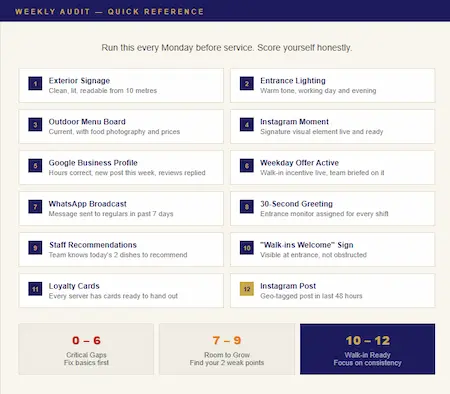
Walk-in Attraction Audit — 12-Point Weekly Checklist
Run through this checklist every week, ideally on a Monday morning before the first service of the week. If fewer than 9 of the 12 points are confirmed, prioritise addressing the gaps before spending a single rupee on external marketing or advertising. The basics must be working before amplification makes sense.
-
Exterior signage — Is it clean, undamaged, fully lit at night, and readable clearly from 10 metres away?
-
Entrance lighting — Is the warm entrance lighting working correctly for both the day and evening service?
-
Outdoor menu board — Is it updated with current dishes, accurate pricing, and at least one high-quality food photograph?
-
Instagram-worthy moment — Is your signature visual element present, well-maintained, and ready to be photographed today?
-
Google Business Profile — Are your hours correct for this week? Has at least one new photo or post been added in the last seven days? Have all new reviews received a response?
-
Weekday footfall offer — Is there a specific walk-in incentive active for the current week? Does your entire front-of-house team know what it is and how to communicate it?
-
WhatsApp broadcast — Has a message been sent to your regulars list in the last seven days? Did it include a photograph and a specific call to action?
-
Warmth Window protocol — Has the team been briefed on the 30-second greeting standard for today's service? Has the entrance monitoring role been assigned for each shift?
-
Staff dish recommendations — Does every server on shift today know the two dishes they should be recommending to first-time walk-in guests, and can they describe them with genuine enthusiasm?
-
"Walk-ins Welcome" signal — Is there a clearly visible sign at the entrance communicating that walk-in guests are welcome? Is the "Table Ready Now" board updated for current availability?
-
Loyalty cards — Does every server have loyalty cards accessible to hand out to walk-in guests at the end of their meal today?
-
Instagram post — Has a geo-tagged Instagram post been published in the last 48 hours?
Score 0 to 6: Critical gaps. Focus all operational energy on the basics before any marketing spend.
Score 7 to 9: Good foundation. Identify your two weakest points and address them this week.
Score 10 to 12: Walk-in ready. Your systems are in place — focus now on consistency and incremental improvement.
Conclusion — Walk-in Footfall Is a Designed Outcome, Not a Lucky Accident
Attracting walk-in customers is not a campaign. It is not a discount. It is not a single creative idea that solves everything. It is a system — a set of reinforcing elements that work together to create a predictable, sustainable flow of new and returning guests through your door. The system has seven components as outlined in this guide: exterior presence, digital visibility, in-store experience, offers and incentives, team execution, performance measurement, and continuous improvement. Weakness in any one of them suppresses the performance of all the others.
The most important insight from more than a decade of restaurant consulting is this: the gap is almost never awareness. Guests in your neighbourhood know you exist. The gap is almost always in the invitation — the clarity, warmth, and confidence with which you communicate that you are ready for them, that they will be welcomed, that the experience will be worth their time and their money.
Run the audit checklist above with genuine honesty. Identify your lowest-scoring area. Focus your energy and attention there for the next four weeks before moving to the next. Progress is not achieved by optimising everything simultaneously — it is achieved by finding and fixing the weakest link in the chain, one at a time, with consistency and intention and leadership from the top.
The restaurants that understand this — that walk-in footfall is a designed outcome, not a fortunate accident — consistently and sustainably outperform those that treat it as a matter of luck or location. Your location matters less than you think. What you do with it matters far more than most operators ever realise.
About Zion Hospitality by Chef Ajay Chopra
Zion Hospitality is India's leading F&B consulting practice, led by Chef Ajay Chopra. We have worked on more than 50 restaurant openings, repositionings, concept developments, and operational turnarounds across India, Dubai, and Southeast Asia. Our consulting work covers the full restaurant lifecycle: location strategy, concept and brand identity, menu development, kitchen design, staff training, walk-in footfall optimisation, and ongoing operational advisory.
If you would like to speak with our consulting team about your restaurant's walk-in performance or any aspect of your F&B operations, we would welcome the conversation.
Talk to a Consultant: www.chefajaychopra.com/restaurant-consultant
View Our Projects: www.chefajaychopra.com/restaurant-consultant